
How to Do a Life Audit in 6 Steps Without the Wheel of Life

When people want to do a life audit, they often start by listing the different areas of their lives and rating them out of 10 based on how satisfied they are.
Those ratings almost always lead to GOALS, which can be both the best thing and the biggest pitfall of self-improvement.
But your life isn’t linear. A 4/10 rating doesn’t necessarily tell you what’s happening in that area, how it affects the rest of your life, or whether anything actually needs fixing.
For example, let’s say you’re ambitious about climbing the corporate ladder.
But this year, you’re recovering from burnout and have deliberately chosen to work fewer hours so you can spend more time with family.
Your career progress slows, so you rate it 4/10.
But do you need to fix it immediately?
If that slower pace is intentional and your work still meets your needs, the rating overlooks your current season of life. It doesn’t mean you’ve abandoned your ambition.
Your capacity, values, priorities, and circumstances all influence how you live. And no area of your life exists in isolation. They’re interconnected.
Understanding this has helped me dig deeper into my own life and find answers beyond random SMART goals and giant to-do lists.
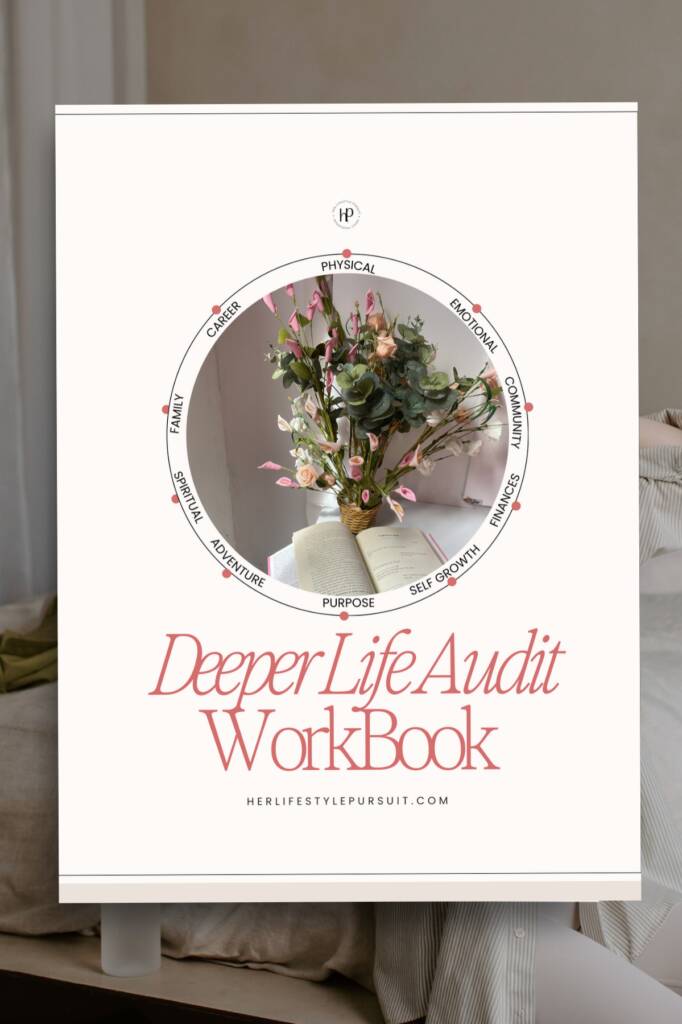
It’s also the approach behind my Deeper Life Audit Workbook, which more than 100 women have used to examine their lives beyond goal setting.
And that’s the kind of life audit we’ll explore together.
You’ll learn how to do a life audit in six steps, answer those heart-tugging questions, and understand what’s really happening in your life without the traditional Wheel of Life or arbitrary satisfaction ratings.
First, let’s establish what a life audit actually means.
This post may contain affiliate links, which means I’ll receive a commission if you purchase through my link, at no extra cost to you. Kindly read the full disclosure here.
What Is a Life Audit?
A life audit is an intentional examination of your life that helps you understand what’s happening across different areas, why things are the way they are, and how those areas influence one another.
It goes beyond measuring how satisfied you feel with your career, finances, relationships, or health. You examine your life in the context of your current circumstances, responsibilities, priorities, and capacity.
The purpose is to uncover what’s behind the questions or concerns that brought you to the audit, recognize what needs your attention, and make informed decisions.
A life audit helps you understand the life you’re living before you start planning the life you want to build.
How to Do A Life Audit in 6 Steps
Follow these six steps to conduct a life audit and assess the areas of your life today.
1. Set Aside Time
Many people start a life audit by rating different areas of their lives from 1 to 10. While I’m biased against this approach, I’d like you to think of your life audit as a Life CEO Day, where you spend time discussing and dissecting your life.
This time, in the boardroom meeting, it’s just you, doing the brave thing (having an honest conversation with yourself).
So, set aside 45 minutes to an hour and 30 minutes. I love to keep mine within an hour so I don’t get overwhelmed.
Find a comfortable position and set the mood. Use background music (if you love it) and scented candles and diffusers. Basically, whatever works for you.
Get a journal, an empty notebook, a notepad, or my Deeper Life Audit Workbook to record and complete your audit.
The Deeper Life Audit workbook is both digitally fillable and printable. You can fill it out digitally using a good ol’ PDF reader, Chrome, or note-taking apps like Xodo and Notability. Or, if you’re a pen-and-paper girl like me, you can print it out and fill it in by hand.
2. Identify the Question That Brought You Here
After several conversations about life audits, guiding other women through the process, and doing my own, I’ve realized the desire to audit our lives usually comes from a question or feeling we’re trying to understand.
I mean, who wakes up one day and says, “Oh, my life is super perfect. I need to audit it”? Hardly anyone, unless they have a lot of time to play around. Lol.
Usually, a recurring question keeps tugging at your heart, even when you try to shake it off. Questions like:
- Why do I feel stuck in my career?
- Why am I constantly exhausted?
- Why do I keep abandoning my goals?
- Why am I unhappy when my life looks good on paper?
- How do I get my life together when everything feels scattered?
- Am I still happy in this relationship?
Maybe you’re wondering how the year is already almost over. Where did all your time go? Or maybe you’ve realized you keep spending your time on things that aren’t important to you.
So, what’s the question that brought you here?
Sit with it for a moment, then write it down. We’ll use that question to evaluate which areas of life to take a closer look at as you work through the audit.
If you’re still not sure if you should audit your life, read my post on the 12 signs you need a life audit
3. Define Your Current Season of Life
As you look at your life through the lens of seasons, you’ll realize discipline may not be the only reason you’re not making progress or hitting your goals.
You’ll also realize why comparing your life to someone else’s makes little sense when you have different responsibilities, capacities, time, and resources.
The concept of a season of life is the idea that your life moves through different periods, each with its own circumstances, responsibilities, priorities, opportunities, and limitations.
Your season of life is the context in which you live, make decisions, set goals, and measure progress.
For example, I’ve always said on my blog, when talking about setting up morning routines, that my routine was that of a single woman living alone and working from home.
At that point, my reality, especially when it came to freedom and time, was quite different from that of someone who was married or worked a regular 9-to-5 job.
And even that has changed since I got married a few months ago. Now I’m in a different season, and adjusting to it feels like life has given me a backhand. Lol. I digress.
Another thing to understand is that your season of life isn’t necessarily one thing. You could be expanding your business, rebuilding your finances, maintaining your health, and adjusting to new family responsibilities at the same time.
So, how do you define your current season?
What’s Happening in Your Life Right Now?
Start with your current circumstances. What has changed in your life recently? Are you navigating marriage, family planning, a career change, business growth, caregiving, grief, or health challenges?
What Does This Season Require of You?
Look at your existing responsibilities and commitments. What demands your time, attention, energy, and resources right now?
For example, someone caring for an aging parent may have less flexibility than they did a year ago, even if their career and personal goals haven’t changed.
What Is Your Capacity Right Now?
I want you to distinguish between your capacity and your capability.
Your capability is what you can do. Your capacity is what you can realistically take on given your current circumstances.
Let’s say you enroll in a 20-module course to develop a new skill that will help you advance in your career.
You’re perfectly capable of completing the course, but between work, family, and other commitments, you only have one to three hours available each day.
Someone with fewer commitments may complete the same course in two weeks, while you need six.
Now, imagine setting a goal to finish that course in two weeks because someone else did.
You’ll end up questioning how “disciplined you’re” when the problem is the deadline you set without accounting for your available time.
What Do You Want This Season to Honor?
Finally, consider what matters to you right now.
But how you allocate your time and resources depends on your circumstances.
For instance, you want to grow your career and spend more time with your family, but do you realistically have the time and energy to pursue both at the pace you desire?
The question I want you to ask yourself is:
“Given the life I’m living right now, what makes sense for me?”
Keep your answers in mind as you move into the next step of your life audit. They’ll help you understand why certain areas of your life look the way they do and whether they need your attention.
This is also covered in the Deeper Life Audit Workbook. The Starting Point section walks you through examining your current season, your available resources, and what matters to you before you begin auditing the areas of your life.
4. Take Stock of Your Areas of Life
Now that you understand your current season, it’s time to examine the different areas of your life.
You can divide your life into 8–12 areas or categories, depending on how you group them. For this audit, we’ll examine 11 core areas, excluding time as a standalone area.
These areas cover your health, career, finances, relationships, personal growth, and environment.
While they all contribute to your overall well-being, you can do well in some areas and struggle in others.
Most importantly, these life areas don’t exist in isolation. What happens in one area affects the others. Some areas have a much bigger ripple effect.
I’ve written an entire guide on the 12 Areas of Life to Set Goals for Balance, where I break down each area and its role in creating a balanced life.
For this exercise, we’ll examine:
- Physical Wellbeing
- Emotional & Mental Health
- Spiritual Life
- Relationships
- Social Life & Volunteering
- Work & Career
- Finances
- Life Purpose
- Self Improvement
- Physical Environment
- Adventure, Fun & Hobbies
Look at What’s Happening Beyond How You Feel About It
For each area, consider how much it matters in your current season, what it requires of you, and how it influences the rest of your life.
Remember what we discussed earlier about rating your life from 1 to 10?
This is where I want you to go beyond those numbers.
A satisfaction score tells you how you feel about an area of your life, but it doesn’t explain what’s happening there or how that area influences other parts of your life.
For example, instead of writing:
Career: 4/10
Write:
“I enjoy my work, and my career matters to me because it supports my financial goals and the life I want to build. But lately, I haven’t had enough time to develop the skills I need for the next stage of my career.”
Or take your health, for example:
“I’m currently recovering from a health challenge, so my physical health is a top priority in this season. It influences how I plan my days and what I commit to. I currently walk 8,000–10,000 steps daily, eat out less, and have been seeing improvements. For now, I’m doing enough in this area.”
Do you notice the difference?
In the first example, you enjoy your work and recognize its importance to your financial goals, but professional development has taken a back seat.
In the second, your health requires attention, and you’re already taking steps to improve it. There’s no reason to add another health goal simply because you’re conducting a life audit.
An area can matter greatly to you without needing more work.
Also, this isn’t the time to start setting goals. At this stage, I want you to give your life an honest dress-down and take stock of what’s happening.
Go through each area and write one or two honest observations.
- What is working?
- What has changed?
- What concerns did you notice?
- And how is each area affecting the rest of your life?
By the end of this exercise, you’ll have a written overview of your life to examine more closely in the next step.

5. Identify the Areas That Need a Closer Look
Now that you’ve taken stock of the different areas of your life, it’s time to narrow your focus.
The purpose of a life audit is to understand what’s happening in your life, why it’s happening, and how it relates to your original audit question.
Choose Three Areas Connected to Your Audit Question
A common problem I’ve noticed in most goal-setting and life-audit exercises is the pressure to set more goals or balance every area of life.
We won’t do that.
Instead, we’ll choose up to three areas that are most relevant to answering your main audit question.
Go back to the question you wrote at the beginning of your life audit and review your observations from Step 4.
Look for areas of your life that could help explain how you feel.
Which three areas would help you investigate that question further?
For example, let’s say your audit question is:
“Why do I feel stuck in my career?”
After reviewing your life areas, you notice:
- Work & Career: You’re dissatisfied with your career progression and haven’t developed the skills needed for your next move.
- Finances: Financial commitments affect how much you can invest in professional development.
- Relationships: You’re planning to start a family, which affects your time and future responsibilities.
I recently fought an internal battle for three months over a career pivot.
I’ve always loved design and aesthetic things. In fact, I have another business where I’m a Canva Creator (create designs for Canva’s library).
However, a few months ago, I kept feeling stuck, trying to ignore a heart-tugging question and my heart yearning to follow what I’ve always loved.
After struggling to understand why I suddenly felt dissatisfied, I sat down, did an audit, and realized I should go back to study design to become a brand designer and creative director.
Now I need money, and to get it, I have to work on my businesses. Time is a big factor for me, as I’m already stretched thin growing two businesses while settling into married life.
Do you see that? How many areas of life have I mentioned?
For me, the three areas worth examining more closely were my career, finances, and relationships, particularly how my existing responsibilities affected the time I could devote to studying.
Plus, I have other minor things to worry about, while staying healthy and maintaining my daily goal of 10,000 steps.
Examine the Connections Between Those Areas
Take a closer look at each of the three areas you’ve selected and how they influence one another.
In my case, I’ve identified a design school I’d love to attend that costs $8.5k; I need to consider how to finance it, how much time I can commit to studying, the program’s duration, and how it fits with my current responsibilities.
Completing an intensive program in three months would require a different level of commitment than spreading the coursework over ten months, which also has pros and cons.
Growing my businesses would give me more money to invest in my education, but it could also demand more time than I have for studying and family. Do you see that?
Now, look at your three selected areas and ask:
- How do these areas relate to the question that brought me here?
- How is what’s happening in one area influencing the others?
- Which connection seems most important to understanding my situation?
Write your findings, paying attention to the connections between your life areas: which ones have the greatest influence on your current circumstances.
If you’d prefer guided questions for examining your selected areas, you’ll find them in my Deeper Life Audit Workbook.
6. Return to Your Audit Question and Identify Your Direction
Remember the question you wrote down in Step 2? It’s time to return to it.
By now, you’ve examined your current season of life, taken stock of your life areas, and looked more closely at the ones connected to your question.
So, what do you know now that you didn’t know when you started?
Return to your original question and compare what you initially thought was happening with what you’ve discovered.
Now, you see why I don’t believe every life audit should end with a list of goals. In some cases, the most useful thing you’ll discover is that you’ve been trying to solve the wrong problem.
To complete your life audit, ask yourself:
- What was I assuming when I first asked this question?
- What have I discovered that supports or challenges that assumption?
- What needs my attention right now, and what can remain as it is?
- Based on what I’ve discovered, what should I do next?
You’ll wrap up your audit with either a clear answer about what to do next or a better understanding of what you still need to figure out. Both are useful outcomes.
In my Deeper Life Audit Workbook, the final Life Audit Snapshot helps you bring your findings together, including what you’ve learned, what deserves your attention, and what you want to carry forward.
Write down your conclusions, decisions, or questions you want to revisit.

How Often Should You Do a Life Audit?
Now you know how to do a life audit, the questions to ask, and the steps to take. So, how often should you do one?
I recommend conducting a life audit every quarter, or once every three months (90 days).
A lot can change in 90 days. Your circumstances, priorities, responsibilities, and capacity can look completely different than they did at the start of the quarter.
Plus, this is also how I approach goal setting. I pick one big goal and work toward it over 90 days. You can accomplish so much in a quarter.
Ready to Skip the Long Steps and Do Your Life Audit?
Instead of piecing your audit questions together yourself, use my Deeper Life Audit Workbook. It takes you from a Starting Point to a completed Life Audit Snapshot in about 45 minutes.
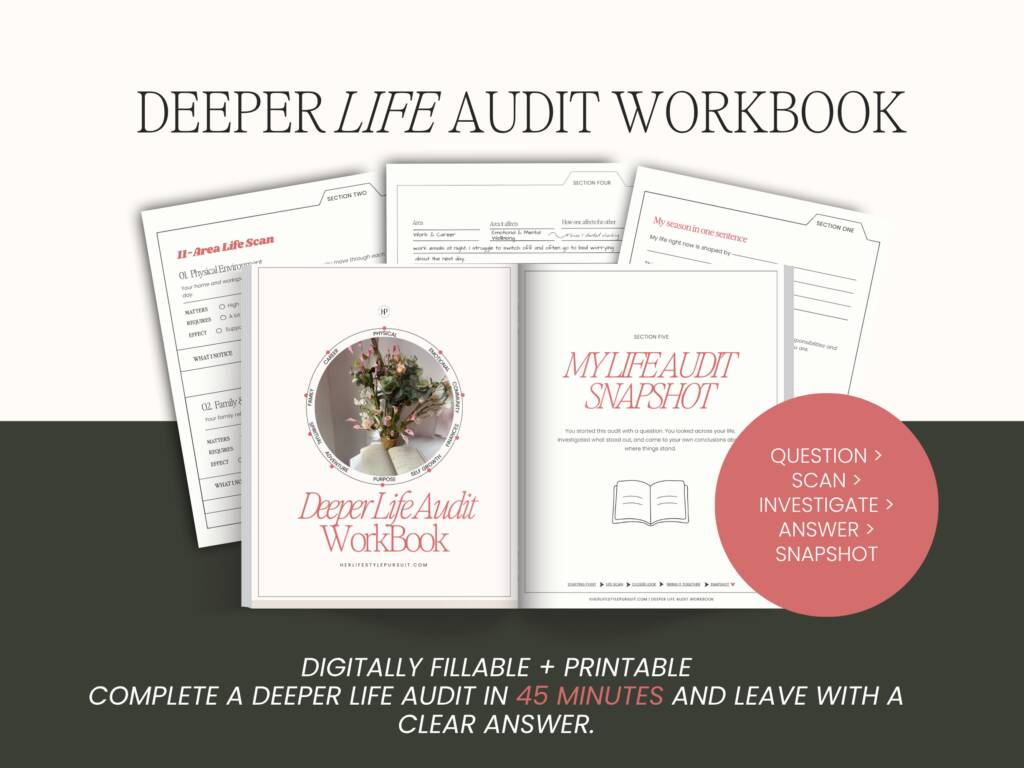
It’s a 38-page workbook with guided life audit worksheets covering five phases.
Inside, you’ll discover:
- Why the problem you came in with might not be the problem you leave with.
- Which areas of your life deserve your attention, and which ones you can stop worrying about for now.
- What’s influencing your current situation, including things you may have overlooked when you first asked your audit question.
- What needs to change, what should stay the same, and what makes sense for this season of your life.
- My five-phase framework for answering the questions that brought you here and figuring out where to go next.
And not to worry, I haven’t filled it with intimidating blank pages and left you to fend for yourself. You’ll find guided questions, multiple-choice options, checkboxes, examples, and writing spaces throughout.
You can print it if you enjoy writing on paper, or fill it in digitally using compatible PDF readers, good ol’ browsers like Chrome and Safari that support fillable fields, or iPad apps like Xodo and Notability.
Found this useful? Save to Pinterest for later.









Join the List
Join "INTENT" the weekly newsletter for women living intentionally, authentically and becoming their best selves.