
12 Things to Do at the Start of the Year to Make It Your Best Yet

The great January, the season when everyone is changing their life 10.0 (or whatever version you’re at right now), is here again.
It’s the season of setting endless lists of realistic and unrealistic goals, making New Year’s resolutions that may not even last a week (studies say so!), and overwhelming yourself so much that you become too scattered and disorganized to take action, or end up trying to do everything at once.
I’m no saint. I’ve had my fair share of 62-item SMART goal lists and New Year’s resolutions that I set and abandoned by the following week.
That was until I learned how to use the Ripple Goal System, build identity-based habits, and, most importantly, make January the month that sets the tone for the rest of the year instead of the month when I start to stall or get overwhelmed.
So, this year, instead of putting so much pressure on yourself to get everything right from day one, I’ll show you 12 things to do at the start of the year, from reflecting on the past year and setting meaningful goals to organizing your life (home, finances, workspace, etc.) and planning your first 90 days.
If you follow these steps, you’ll have a practical plan to take action daily without feeling like you’re doing too much. Most importantly, you’ll set goals that you’ll actually enjoy smashing.
This post may contain affiliate links, which means I’ll receive a commission if you purchase through my link, at no extra cost to you. Kindly read the full disclosure here.
12 Things to Do at the Start of the Year
So, without further ado, here are 12 things to do in January to start the new year right.
1. Review and Reflect on the Previous Year
Before you touch anything this New Year, start with an audit. Review and reflect on what worked and what didn’t in the previous year.
Here’s what I do. I take a journal and ask myself: Who was I last year?
I imagine I’m looking at myself from an outsider’s perspective, and I write down everything I observe about my habits, routines, goals, relationships, achievements, failures, challenges, lessons, things that made me happy, resentments, limiting beliefs, the seasons I went through in the previous year, and where I spent my time.
Think about it like you’re writing a detailed essay about yourself.
Doing a brain-dump reflection and then reading through it before setting any goals helps me be completely honest with myself. As I read through what I’ve written, I begin to discover patterns I never thought about.
For example, this year, after doing my audit, I realized that the reason I wasn’t achieving my goal of growing my business Instagram account wasn’t just because I hated making videos and being on social media (I really do hate it), but because I was stuck in my comfort zone.
Now, having done that brain dump, you can answer these questions:
- Who was I at the beginning of the year, and how have I changed?
- What did I promise myself I’d do but didn’t, and what got in the way?
- What promises did I keep to myself, and what helped me follow through?
- Where did I spend most of my time, energy, and attention? Did that reflect what mattered to me?
- What do I want to continue, change, or leave behind as I enter the new year?
After reflecting on the previous year, it’s time to decide on the areas of life you want to work on this year.
People tend to overcomplicate things by setting big goals in every area of their lives because they want balance. In the end, they do nothing or achieve less.
Instead, look at your life through the lens of seasons.
What season are you in right now? What’s your capacity right now? Consider your time and availability, how much you can commit to chasing a particular goal or area, your resources, and which areas of life will have the biggest impact if you work on them right now.
Those are the core areas you should be working on.
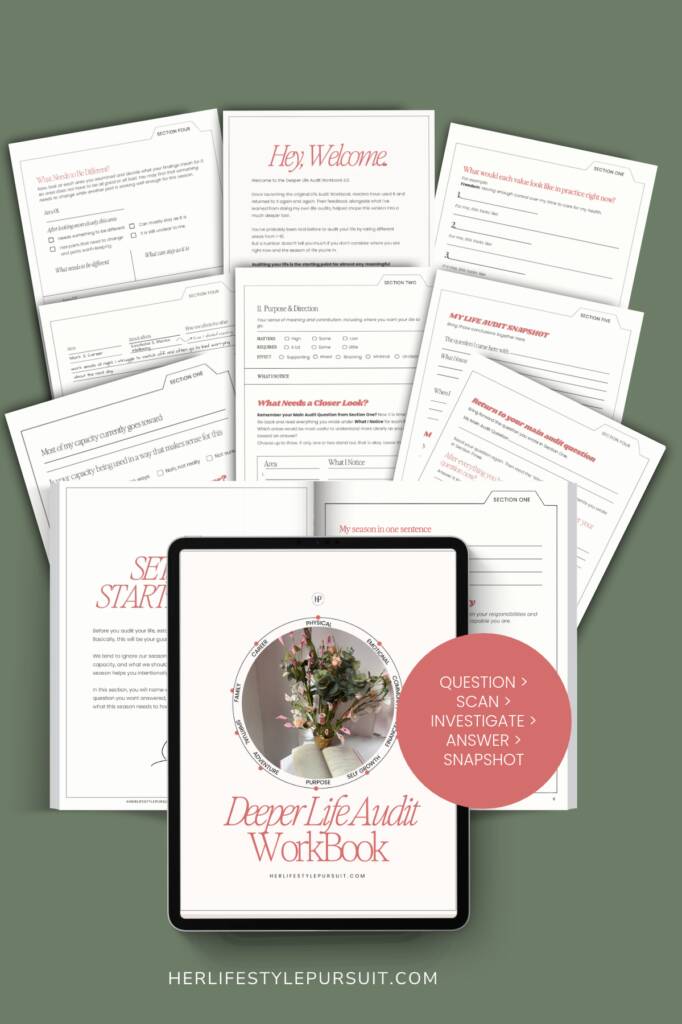
You’ll see more of this in the Deeper Life Audit Workbook. It helps you approach your life by answering the core question tugging at your heart right now. Then you dig deeper to understand why things are the way they are, and pick 2–3 areas of life to work on at a time.
The audit takes about 45–60 minutes to complete.
2. Decide Who You Want to Become
You’ve reflected on who you were last year and how that person served you. Now, you’ll decide who you want to become before setting any goals.
Who is this person? What do you believe in right now? Do those beliefs align with the beliefs of the person you want to become?
Let’s say you want to hit six figures in business this year. A consistent six-figure business owner doesn’t operate from a scarcity mindset or allow limiting beliefs to dictate every decision.
She understands that growing a business requires making uncomfortable decisions, investing her time and resources wisely, showing up consistently, and doing things she doesn’t necessarily enjoy.
For example, you want to grow your business but keep avoiding marketing because you’re uncomfortable putting yourself out there. Is the goal the problem, or the behavior that needs to change?
A few years ago, I was the girl who struggled with self-confidence, and deep down, it led to not knowing how to say no, people-pleasing, seeing myself through the lens of someone unworthy, and every other struggle that comes with not loving yourself enough.
When I decided I wanted to change that, I had to learn all the ways someone who loves herself unconditionally would behave, how she would speak to and about herself, and how she carries herself.
That has changed my life.
So, the belief is as important as the goal.
Exercise: Compare Your Current Habits With Who You Want to Become
If you want to become someone who manages money well, what spending habits need to change? If you want to become someone who is consistent, how will you handle the days when you don’t feel motivated?
The same goes for becoming a healthier version of yourself. What beliefs does this person hold? How does this person eat, sleep, handle tasks, and spend their day?
Write down who you want to become and the habits this person has. Then, compare them with your current habits. Think of it as a review of your life.
For example, if you want to become a confident person, how does a confident person think and act? How does she speak to herself, handle uncomfortable situations, and set boundaries? Now, compare that with how you currently behave.
Identify the beliefs and behaviors you need to let go of and the ones you need to start practicing.

3. Choose a Word or Theme for the Year
Now that you’ve reflected on who you were last year and decided who you want to become, choose a word or theme that captures what you want this year to represent.
Think of it as your mantra: a guiding word or phrase you’ll anchor yourself to for the rest of the year.
For example, last year, after my audit, I realized I wasn’t smashing my goals in previous years because I lacked discipline. Instead, I had shiny object syndrome.
My anchor for 2026 was “Get It Done.” This helped me focus on finishing what I started and stop procrastinating.
I also like to anchor my word or theme for the year in a Bible verse. Last year, mine was Jeremiah 29:11: “For I know the thoughts that I think toward you, saith the LORD, thoughts of peace, and not of evil, to give you an expected end.”
This year, I’m turning 30, making a 180-degree career change, and have so many big, scary things I want to do. So my theme is Fresh Start and Go Big.
To choose yours, look at what you discovered during your reflection and think about what you want this year to represent. What do you want to change, improve, or do differently? Choose a word or short phrase that captures that intention and reminds you of it throughout the year.
Your theme could be *Consistency, Courage, Financial Freedom, Less but Better, Progress Over Perfection, Healing, Mindfulness, Open to New Beginnings,* or *Love.*
Keep in mind what the word or theme you choose represents to you (it’s personal, after all).
4. Set Your Goals Using the Ripple Goal Method
Now, on to the famous thing to do at the start of the year: goal setting.
You’re going to set SMART goals in the areas of your life you want to improve to help you become the person you desire to be.
SMART stands for Specific, Measurable, Achievable, Relevant, and Time-bound.
For example, instead of saying, “I want to improve my finances this year,” a SMART goal would be, “I want to save $6,000 by December 31st by setting aside $500 every month.”
See the difference? The goal is Specific because you know exactly what you want to achieve, Measurable because you can track how much you’ve saved, Achievable if saving $500 monthly is realistic for your income, Relevant because it supports your financial goals, and Time-bound because you’ve given yourself a deadline to achieve it.
However, instead of making a long list of goals you may never peek at again until the end of the year, you’ll use what I call the Ripple Goal Method to filter your goals.
I created this system to beat procrastination and overwhelm.
So, how does it work?
First, identify your Ripple Goals. Look at all the SMART goals you’ve written down and ask yourself: Which of these goals, if achieved, would positively impact several other areas of my life?
For example, let’s assume my goal is to make $120K from my business by the end of Q2.
If I achieve this goal, the impact goes beyond my business. I could fund my vacations and trips, set aside money for savings and investments, buy back some of my time, and spend more quality time with my family.
How many areas of my life would that one goal positively affect?
That’s the idea behind a Ripple Goal.
Choose a few goals with this kind of impact and make them your main priorities.
Next, identify your supporting goals. Go back to your original list and pick out the goals that are still worth achieving but don’t create as significant a ripple effect.
For example, reading 20 books a year or listening to 30 podcast episodes. These goals are worthwhile, but they may not have the same far-reaching impact as your Ripple Goals.
The idea is that not all goals require the same level of priority, attention, or resources.
Finally, create your action plan using the Goal Cascade Framework. Once you’ve separated your Ripple Goals from your supporting goals, look at the months ahead and break each goal into smaller milestones and actionable steps.
This way, you’re not just setting goals and hoping you’ll achieve them. You’re making sure that each month, you take meaningful action toward them, with your highest-impact goals getting the most attention.
Both the Ripple Goal Method and Goal Cascade Framework are part of the Her Lifestyle Pursuit Balanced Goal Clarity Playbook, designed to help you set meaningful goals that you’ll follow through on without feeling pulled in different directions.
The playbook launches on December 1st. Sign up to be the first to know when it goes live.
5. Create Your Vision Board
Making vision boards is one of the fun things people look forward to doing in January to start their year.
Your vision board visually represents your goals and aspirations. It helps you keep your goals and dreams in view so you can work toward them and manifest them.
I love making vision boards and never skip them.
For example, if your goal is to travel to three new countries this year, include pictures of those destinations. If you’re working toward financial stability, add images or words that represent what achieving that goal would mean to you.
Use images, words, and quotes that reflect the goals you’ve set for the year.
You can make a digital vision board using Canva or use magazines, printed pictures, and a poster board.
A hack I follow is to create my vision board in Canva, then resize it for my desktop. I also save it as a flattened PDF, print it, and frame it. This way, you don’t have to hunt through old magazines.
You can get Canva for free for 30 days using my affiliate link.
Keep your vision board where you’ll see it regularly, whether that’s your desktop, bedroom wall, or workspace.
If you’re not sure how to create a vision board, read my Vision Board Checklist to learn the four must-haves of a vision board. You’ll also find vision board quotes and Bible verses to include on your board.

6. Put the Year’s Important Dates on a Calendar
Get your calendar out and mark down all the important dates and events you already know are happening this year. Birthdays, anniversaries, public holidays, planned trips, weddings, appointments, work deadlines, and other commitments.
This gives you a clearer picture of your year, including the months likely to be busier than others.
This is also where you’ll notice one of the biggest goal-setting pitfalls. People set goals as though they’ll be working 365 days a year, with 100% commitment and capacity throughout the year. And because they don’t account for the different seasons of their lives, they struggle to complete the tasks and goals they’ve set for themselves.
For example, if you have a two-week vacation planned for June, you can factor that in when setting your goals and deadlines for the second quarter. The same goes for months with major family events, work commitments, or celebrations.
Blocking out important dates at the start of the year also helps you plan ahead for events that require financial commitments and other expenses.
Use Google Calendar, a digital planner, or a physical calendar, whichever works best for you. Having these dates in one place helps you set realistic expectations for your time and capacity throughout the year.
7. Set Up Your Finance System for the Year
What are your financial goals and plans for the year? This is the time to set up financial systems that will help you stick to those goals.
Start by reviewing your income, expenses, savings, and any outstanding debts. Look at where you spent money last year and identify expenses you can reduce or eliminate.
Check your subscriptions, too. You might be surprised by how much you’re spending on apps, memberships, and services you barely use.
Next, create a budget for the year. Account for your regular living expenses, savings goals, debt repayments, and other financial priorities.
If you have a savings goal for the year, set up automatic transfers using a savings app or your bank. The same goes for debt repayment. You can schedule automatic payments so you’re consistently working toward paying off what you owe.
Remember those important dates you added to your calendar earlier? Go through them and identify events that will require money, such as birthdays, weddings, vacations, and holidays. This way, you can start setting money aside for those expenses instead of scrambling when they come around.
I also recommend setting up a budgeting spreadsheet or using a budgeting app to track your income and expenses from the beginning of the year.
Make it a habit to review your finances at the end of each month so you can see where your money is going and adjust as needed. I’m shocked every time I shop at the market because I start wondering if I misplaced my cash. Like, how did all that money disappear so fast?
8. Declutter and Organize Your Life
I’ll be honest with you. I don’t like decluttering and organizing my life in January. I prefer to do these things at the end of the year because it makes me feel like I’m stepping into the new year with a clean slate.
But that’s my preference, and there’s no right or wrong time to do this. If you haven’t yet, decluttering and organizing your life is one of the best things you can do in January to start the year right and regain control.
I wrote a blog post 100 ways to organize your life, with a step-by-step breakdown.
To organize your life, start by breaking it down into categories:
- Your mind and mental space.
- Your home and physical space.
- Your work.
- Your commitments and relationships.
- Your digital space.
The 30–60-minute daily habit we’ll discuss in number 10? Read that up; this section is a good time to put it into practice.
Assess each area of your life, especially your physical space, and decide what to keep, donate, recycle, or throw away.
Instead of overwhelming yourself, work on one area at a time. I love to do this over the course of a week or so, but you get to decide how long you need.
I work on my physical space one room at a time, going through my pantry, drawers, cupboards, and other spaces.
For my emails, especially promotional emails, I bulk-delete everything I no longer need. If you want to start with a clean slate, archive your emails, declutter your desktop, and organize your digital files and folders.
In my blog post on how to organize your life, you’ll also learn how to create systems to help you stay organized, such as meal prepping, using storage organizers, and more.

9. Plan Your First 90 Days
The quarter (90 days) is such an underdog in goal setting. People get super excited about setting annual goals but fail to use the quarters of the year to achieve them.
If you don’t want to abandon your goals for the new year, make them difficult to abandon.
Look at the Ripple Goals and supporting goals you’ve set for the year and decide what you need to accomplish within the first 90 days.
For example, if my goal is to make $120K from my business by the end of the year, I’ll need to ask some important questions. Where is my business right now? What does my business need to generate that revenue? Do I have the right offers? Do I have a sales funnel in place? How do I attract warm leads?
Answering these questions will help me determine what to prioritize in the first quarter.
Another example is the career change I’m currently working toward, which is almost a 180-degree shift from what I do in my other business.
I knew I had to study for it, so I went looking for a school and found the perfect one. The school offers a three-month intensive program that requires eight hours of study a day, as well as a ten-month part-time program.
Since I want to set myself up for new opportunities at the beginning of the year, I’m opting for the first option. That’s a big goal in itself, but accomplishing it in the first quarter is only a fraction of my overarching financial goal for the year.
The same applies to weight loss. If your goal is to lose 40 pounds over the year, you could use the first quarter to establish healthier eating habits, build a consistent exercise routine, and work toward losing your first 10 pounds, if that’s realistic for you.
Once you’ve established your quarterly goals, break them down into monthly milestones and actionable steps. This gives you a clear direction when setting your January goals.
I used to set goals in January and abandon them until it was time to cry about why I didn’t achieve them. That changed when I started using the quarter to my advantage.
It has helped me run this blog and another business without sacrificing my personal life. I’ve been able to pick up new hobbies, go for daily swims, read books, and take classes on the side without feeling like a loser.
This and more is what I cover in the Her Lifestyle Pursuit Balanced Goal Clarity Playbook.
So, if you must do one thing in January to start the year right, set up a goal system that works for you. The playbook helps you create that system.
10. Start a 30-Minute Habit to Build Momentum
Remember the five-minute rule, where you commit to doing something for just five minutes to overcome procrastination? The idea is that once you get started, you’re more likely to keep going.
You’ll apply a similar principle at the start of the year to build momentum toward your goals.
One thing to do in January to start the year right is to get into the habit of working on your goals and making changes that align with the person you want to become.
Dedicate 30 minutes to an hour daily to a habit or task that brings you closer to becoming that person.
This is why it’s important to know your big goals and the smaller goals that help you become the person you journaled about at the beginning of this blog post.
To put this into perspective, let’s say you want to become healthier, and your version of being healthy involves losing weight, building muscle, and eating right. Dedicate 30 to 60 minutes of your day to walking, exercising, or hitting the gym. The same applies to other goals.
At the start of the year, I had a goal to learn how to swim, and I eventually started dedicating an hour to it.
I walk from my house to the gym, which takes about 15–19 minutes, depending on how fast I’m walking. I do my cardio and other exercises, head to the swimming pool on the same premises, and then walk back home.
Now, this is a big win for me because I work from home, I’m always indoors, and I hate going out so much. During my walk to the gym, I get to take in some fresh air and be human, lol. Learning how to swim has also been great for my mental health.
I get all of this done in two and a half hours. Since starting this routine in October, I’ve lost 5 kg, and we’re only in November.
I also use this method when I need to grow my business or take a course I know I’ll procrastinate on. In 2024, I dedicated the first two hours of my workday to Pinterest and grew my account from 200k impressions to 1 million impressions within 45 days.
Use this method to consistently work on important goals, build habits, and learn to show up for yourself.
30 minutes a day adds up to 45 hours by the end of your first 90 days. An hour a day gives you 90 hours. Imagine how much progress you could make toward a goal you’ve been putting off.
11. Set Up Weekly and Monthly Reset Routines
Your weekly and monthly reset routines serve as guardrails for your goals, resolutions, and plans for the year. They act as checkpoints to keep you focused on what matters to you.
I could never start a new month or week without spending an hour resetting my life. It feels like I’m getting a fresh start and regaining control.
During your monthly reset, take stock of how the previous month went. Review your goals, finances, relationships, commitments, and calendar. Reflect on how well you took care of yourself, declutter your home, and organize your space.
I have a full blog post on how to do a monthly reset if you need help building your routine.
As for my weekly reset, I do mine on Sunday evenings. I review my goals from the previous week, reflect on what I achieved, what I failed to accomplish and why, and set goals for each day of the upcoming week.
Most importantly, these aren’t random goals. My weekly goals stem from my monthly goals, which stem from my quarterly goals, and ultimately, my annual goals.
This is part of my HLP Goal Cascade Framework, which I cover in the Her Lifestyle Pursuit Balanced Goal Clarity Playbook, where you’ll learn how to set goals that feel like you.
So, one of the things to do in January, while you’re still motivated to make this your best year, is to create a system for checking in with yourself. Weekly and monthly resets help you do just that.
12. Create a Reward System and Plan Self-Care and Solo Dates
I’m a huge fan of living while living. That’s the whole point of Her Lifestyle Pursuit, and those on the INTENT newsletter list (HLP’s insider newsletter where the hottest dibs and gist drop) have heard me say this a zillion times.
You can sign up using this link if you’re an outsider right now… (coughs).
I digress.
So, while you set your lofty goals for January and plan all the big things you want to do this year, create a reward system and plan your self-care.
You’re human, not a robot who works 24 hours a day, 365 days a year. You cannot pour from an empty cup.
So, one of the things I do in January is ask myself: How can I love myself better? How can I reward myself for showing up and doing difficult things daily?
Think about what you can do to make yourself happy. I like to separate these into two categories: rewards and non-negotiable self-care.
Rewards
A reward is a treat you give yourself when you hit a milestone, achieve a goal, or do something brave.
You finally started that Instagram account to market your business after putting it off forever? Buy yourself your favorite drink. You smash a big goal on your list? Take yourself on a staycation.
For example, after I launched the Mid-Year Reset Playbook, I took myself on a weekend trip.
Now, this doesn’t mean you should only gift yourself something when you achieve a goal. It’s more of an incentive (think golden retriever).
I bought myself a beaded bag I’d been eyeing after consistently sending out newsletters for 90 days because I’d struggled with consistency in the past.
Also, this isn’t the time to splurge or get into debt. Your reward should be within your budget and cost only a fraction of your income.
In my case, I emailed for 90 days, made money from my email list, and spent $50 on the bag. Makes sense, right?
Non-Negotiable Self-Care
The second category is self-care activities that aren’t tied to achieving any goals. These are activities you intentionally include in your weeks, months, and year to recharge.
Here are some self-care activities to include in your plans:
- Journaling.
- Going on solo dates every month.
- Incorporating self-care into your morning routine.
- Taking up new hobbies. Here are some fun things to do when you’re bored.
- Having self-care showers a few times a month.
- Spending the first 30 minutes of your morning alone, enjoying your coffee or tea without interruptions, especially if you’re a mom or caregiver.
- Going on vacations.
Basically, these are things you do for yourself because they make you happy.
Here are some fun things to do alone on a Friday night.
Planning these activities ahead of time helps you prioritize yourself so you don’t get caught up in chasing goals and end up burned out.

What You Shouldn’t Do at the Start of the Year
January is the time of year when everyone is on a high, ready to change their lives.
Yet people fall into the trap of overwhelming themselves from the start with a long list of “New Year, New Me” goals instead of creating an actionable plan.
By mid-year, they’re already feeling sorry for wasting the year.
Don’t make the same mistake!
When you treat your goals as part of an interconnected system that affects multiple areas of your life, you’ll see how much you can achieve by breaking them into actionable steps and organizing them into quarters and months, instead of treating them as a disconnected to-do list.
This is the system I use and teach in HLP’s Balanced Goal Clarity Playbook.
It helps you set yourself up to make the most of the year while honoring your season of life, prioritizing self-care, and moving through the year with intention and goals that feel like you.
You’re actually excited to get to work in the first 90 days without feeling overwhelmed.
Found this useful? Save on Pinterest for later.









Join the List
Join "INTENT" the weekly newsletter for women living intentionally, authentically and becoming their best selves.